Sunday, 9 May 2010

The Manu Jungle


The lodge in Pilcopata was very nice, waking at 6am for a cold open air shower was an experience... What a great way to wake up! We had a fantastic cooked breakfast, my first one in South America, and a nice change from bread. It was only an hours drive to the boat in Atalaya, but the road was very very boggy and the minibus got stuck in the mud just after driving through a waterfall. Everyone got off and the drive jacked the bus up to place rocks underneath the tyres, but that didn´t work. A couple of passing motorcylists stopped to help too and eventually we were on our way again. We took a long boat from Atalaya to our lodge for the night, Soga De Ora. We had to walk through a very muddy and slippy jungle path with our luggage to the lodge but as we walked into the clearing and caught our first glimpse of the lodge we all said wow! It was so beautiful and looked so tranquil. There were a couple of large wooden lodges on stilts with decks and hammocks to chill out in, perfect!
After lunch, we put our wellies on and took the boat across the river to a hiking trail. It was amazing, really boggy underfoot and lots of log walkways to negotiate over the really muddy parts. Our guide Fredy was brought up in the jungle in Atalaya so had really good local knowledge of the area and all the animals, flora and fauna. We took a raft, literally some logs bound together, and with an inch of water round our ankles, we punted across the lagoon. It was so relaxing and we saw plenty of different birds. On the other side we took another trail through the rainforest. We returned to the raft as it got dark, and punted back across the lagoon in the pitch black looking for caymen eyes glowing in the water. The night sky was amazing, the stars were so bright, and the jungle noises were so clear. We hiked back through the jungle to our boat, which was fun in the dark. An absolutely fantastic day, the jungle was everything I expected and more!

On day two we got up at 5am to visit a clay lick in the river bank, where parrots and parakeets meet to feed on the mineral soil and salt to supplement their diet. It had rained all night and only stopped just as we left so we didn´t get to see many parrots. We had a great breakfast on the boat of pancakes and papaya, before heading down river for another hike. We took a very steep and tricky path and as it had been raining all night, it was very slippy and boggy, with lots of streams to cross on narrow log bridges with no hand rail. I have discovered that I don´t enjoy crossing log bridges as I worry too much about falling in. It rained nearly the whole time we were hiking and our ponchos came down past our knees which made it difficult to clamber over logs and I kept tripping up mine on the steep paths. The highlight for me was seeing some small monkeys high up in the trees towards the end of our hike, they were so cute, it made it all worthwhile. I was relieved to make it back to the boat without having fallen in the mud or in a stream, despite some near misses! We had lunch back at the lodge and a rest in the hammock, before catching the boat back to Atalaya, and then our bus back to Pilcopata for our last night in the jungle.

We had another early start the next day for our long, bumpy journey home. It was a fantastic 4 day adventure, and I loved every minute of it.

The Road to Manu


It was an early start, a 5am pick up, for our trip to the Amazon jungle. The Manu National Park is about an 8 hour bus ride from Cusco. It was a climb of 700m, from 3,300m in Cusco to 4,000m above sea level at Acjanaco, the entrance to the Manu National Park. Haya and I had hoped to get some sleep on the journey, however the roads were nothing more than dirt tracks with massive holes, that twisted and turned, so sleep was impossible, with frequently being bumped up and down in our seats. However the breath taking views more than made up for it. On the way, we visited Ninamarca Cullpas, which are tombs built by a pre-Inca culture-Lucapas. These small towers in the mountainside were used to bury chiefs and important statesman between 800 and 1100AD. From Acjanaco we started to descend into the cloud forest.

The cloud forest was impressive and really felt like I had entered the jungle. The clouds hang over the top of the Andean Mountains, creating a mysterious air over the forest. Until the 1970´s the Manu Park was inaccessible to vehicles until the government blasted a road into the mountainside, taking them 20 years to build. The road has a sheer drop on one side and at every turn there is a waterfall streaming across the road to negotiate in the minibus, often creating sheer mud baths, luckily our minibus slipped its way through without getting stuck. We took a walk in the cloud forest and saw lots of butterflies, monkeys and birds. The brown capachun monkeys got very close to us, they were not afraid of humans, it was so exciting. To see monkeys so close up in their natural habitat and not in a cage was fantastic.
The Cock of the Rock is the national bird of Peru, it is bright red with a grey and white tail, absolutely gorgeous. The male does a ritual dance and sings loudly to attract females, females choose a mate and they go off together for the evening. The female is left to look after the eggs, while the male is free to dance again the next day and attract a new mate. (Sounds like a night at Inkateam nightclub in Cusco!)

We arrived in Pilcopata, a small jungle village, just as it got dark, and stopped in a wooden lodge on stilts. It´s very humid in the jungle which was a nice change after the cold nights of Cusco.

Sunday, 25 April 2010

Lake Titicaca


I had the most amazing weekend in Lake Titicaca, with Haya, my housemate, and Lucy, another i-to-i volunteer. The 6 hour bus ride Thursday night turned into 8 hours and we got to the hotel in Puno at 6.30am and had to be ready for 7am to be picked up. We managed a quick hot shower and breakfast and then were on our way again.

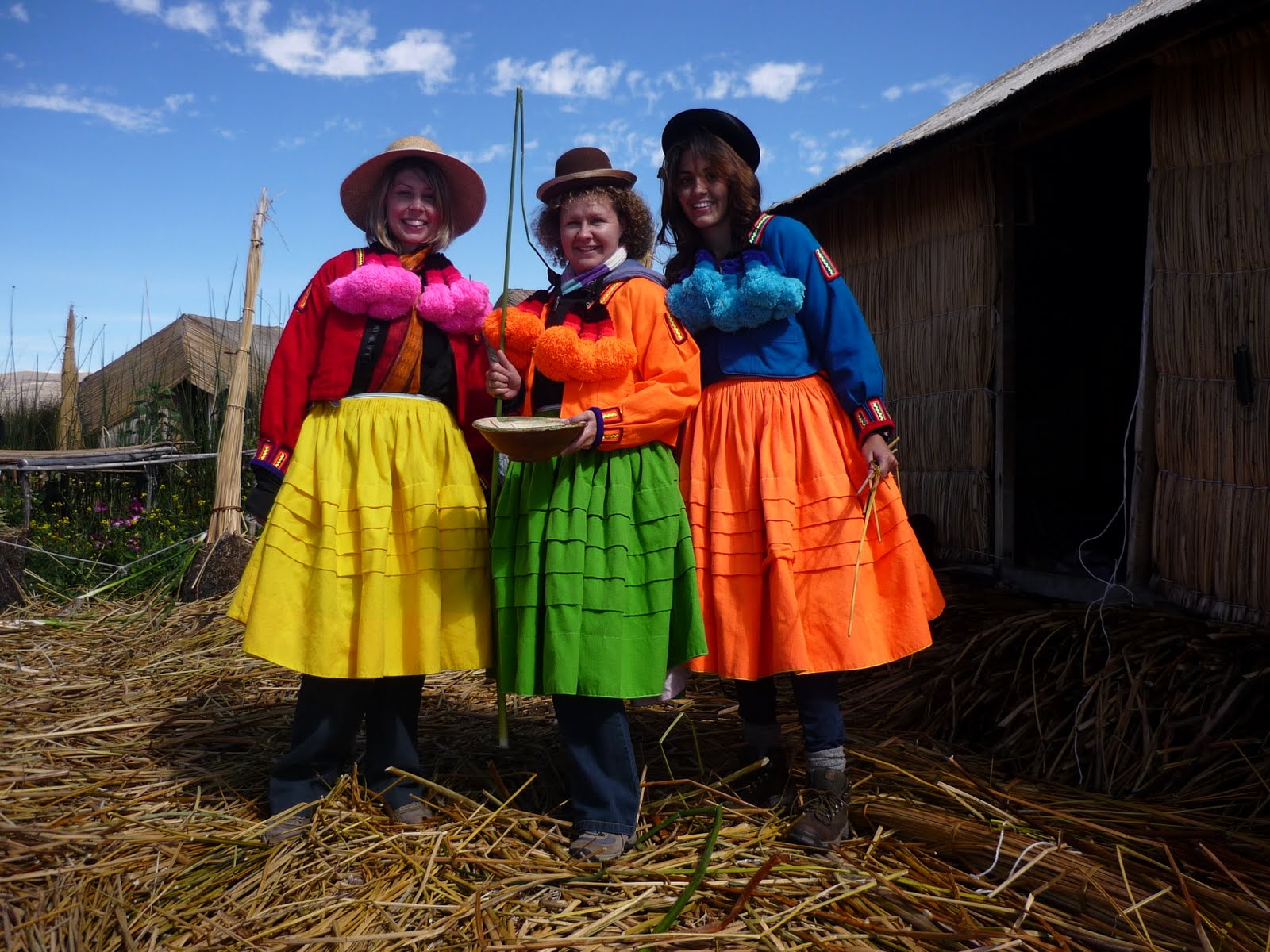
The view of Lake Titicaca was spectacular just from the shore at Puno so I knew the day was going to be fantastic. We visited the Uros Islands first. They are very small, floating islands, made from totora reeds, about 2m deep, with lots of reeds strewn on the top, and bound together with rope. As I stepped off our boat, I wondered if I was going to fall through as it was very soft underfoot. The women wear really brightly coloured clothing, massive wide skirts and little jackets. All three of us dressed up in these clothes which looked hilarious with our hiking boots. Mainly women and young children live on the islands as the men and older children go to Puno to work or school. We were shown inside their houses, also made of reeds, which of course were very basic, but the reed bed looked quite comfty. The Uros people trade goods and sell the clothes they make to tourists. The Islands start to rot after 20-25 years and so they have to build new ones. It was an amazing experience to see how the Uros people live and I couldn´t begin to imagine living on such a small island permanently, it would drive me crazy. We had a ride on one of their boats to the next island, which was really relaxing, Haya had a turn at rowing and we nearly went round in circles.

After the Uros Islands, it was a 3 hour boat ride to Amantani Island, here we were collected by our homestay hosts. Ours was the tiniest lady I've ever seen, about 3ft tall. We had a shared room between the 3 of us, which was clean but had no electricity. Solar power lit the bulb in our room. We had to go outside to the next building for the toilet which had no running water, thank god for hand santiser.... and we had to flush the toilet with a bucket of water, so that was fun. We had a meal of soup (of course), followed by 3 types of potato, cucumber, tomato and fried cheese. We met the rest of our group in the Plaza and took a very steep hike up the side of a very steep hill to a ruin called Pachamama (mother earth), where we walked round 3 times for luck, once for wisdom, once for job , and once for love. Hope it works! I struggled with the climb as felt the effects of the higher altitude but was glad I made it to the top. The view was spectacular, although it had started to get dark. There are no roads or vehicles on the island,it's very peaceful. There was no street lighting at all, so luckily I had remembered my torch to get back home. We had another meal cooked by our homestay host of soup, and then rice, and vegetables mixed with egg, which was delicious.

The following morning, we caught the boat to the next island, about an hour and a half away called Isla Taquille. They speak Quechua here and have a strong sense of identity. The men knit and the women work the land. Their hats look like Wee willy winky hats and the colour signifies if the men are married or single , and the size of the womens pom poms indicate their status. We climbed a steep path to the main plaza which had a fantastic view of the lake. We had a lunch of soup and then trout, it was lovely. 500 steps down then took us back to the boat.

It took 2 and a half hours to get back to Puno and we then had some free time before catching the night bus back to Cusco. Puno is small but nice, with a main plaza and lots of restaurants and cafes. A typical Peruvian town. What a great weekend!

Monday, 19 April 2010

The Sacred Valley Tour, Cusco


After getting in at 4.30am, and with 3 hours sleep, Lilja and I went on the Sacred Valley coach tour. Despite the beer and free rum and cokes the night before, we both felt ok, which was a good thing as the roads were windy, steep, and hilly. The scenery was fantastic, really spectacular, lots of snow capped mountains, and lush hidden valleys.
First stop was Pisac, a small town with a Sunday market. The market was very bright and colourful, with a lot of women dressed in traditional Peruvian clothes. We then visited the Inca ruins, which were very impressive. Our guide was very knowledgable and spoke good English. Then on to Ollantaytambo, a very quaint,and picturesque village with narrow cobbled streets. The Inca ruins are a large fortress built into the mountainside. We climbed 310 steps to reach the top. The view of the valley was spectacular. We stopped for lunch at a buffet restaurant serving traditional Peruvian food, all you can eat for 20 soles, about 5gbp. Lastly, we stopped at Chinchero, Inca ruins, with pretty cobbled streets and an ornate church at the top. The tour started at 9am and finished at 7.30pm, it was a very long day, with a lot crammed in, but I thoroughly enjoyed it. I have found so far, that no matter where you go, there will be a Peruvian trying to sell you something.
I climbed up to the Cristo Blanco on Saturday morning, a large statue of Jesus Christ on the top of a hill, you can see the whole of Cusco from there. Cusco was called the earths navel by the Inca´s. There were women at the top selling clothes and water. At every ruin there were street sellers, and they are very persistent, sometimes using their children to guilt trip you into buying something. Apart from that, Peru is a fantastic country.

Saturday, 17 April 2010

SeƱora De Fatima School, Wanchaq, Cusco

My school is only a 10 minute walk from my house, in the district of Wanchaq, Cusco.
I actually have a timetable for school and it´s Monday to Friday...5 days a week, what a shock to the system after my 2 or 3 days in Argentina. My hours are either 8.15am to 1.15pm or 9.45am to 1.15pm, so I still have most of my afternoons free. The English teacher isn´t fluent in English but much better than the Argentinian teachers and she has no problem understanding me, so I think it´s going to be a good experience. We have 6 grades, 2 classes per grade, from 5 to 11 years, but they´re all at the same basic level of English, so we teach the same things to each grade more or less. They´re are 40 children in a class so discipline is a big issue, even with 3 of us, myself, Haya, the other volunteer, and Margarita, the English teacher, it´s hard to keep control. The children behave in a similar way to the Argentinian children, they get up, wander about and chat to their mates, with little interference from the teachers. The children are very affectionate and at beginning of classes and at breaktime always come and kiss you to say hello.

Friday, 16 April 2010

My homestay in Cusco, Peru


I was picked up from Cusco airport by Juan Ochoa who is my homestay host. He is really lovely, his wife Teresa is very sweet too, and they made me feel at home straight away, as soon as I walked in they sat me down at the dining table to drink mate de coca, which is a herbal tea that is supposed to help altitude sickness. Then they insisted I go to sleep for 3 hours. When I got up at 7pm my dinner was waiting for me, what service!

Their daughter Roxanna also lives with them and does most of the cooking.
Roxanna´s daughter, Karina and her 6 year old daughter, Jasmine, are also around alot so it´s a real houseful. It´s more of a homestay than a guesthouse, as although my room is in a different part of the house, we use their main lounge and dining room to eat and watch t.v. Breakfast is waiting on the table most mornings, usually bread and marmalade and fruit. Dinner is at 2pm after school every day, 3 courses, soup, main and then fruit.

There is another i-to-i volunteer staying there too, we are both teaching English at the same school nearby, her name is Haya and she is from Jordan, although English isn´t her first language, it´s very good as she lived in London for 3 years as a student.

Quite often we all sit down and eat dinner together, and I have been surprised this week that I understood some of the conversation in Castellano. It will be good to practise and improve my Castellano, as none of the family speak English so I have to find the words to communicate with them. Unfortuantely Peruvian Castellano is slightly different from Argentinian Castellano, so I am having to relearn some pronounciation.

Juan and Teresa can´t do enough for you, so I think I will thoroughly enjoy my stay with them.

Thursday, 15 April 2010

Lima, Peru


I flew to Lima in Peru, from Buenos Aires, which is about a 4.5 hour flight. I was collected by my i-to-i homestay host and driven to my new home for 2 days in the Miraflores district of the city. Lima is a very large city and there are 47 districts altogther. Also staying at my homestay is Lilja, from Germany who is doing an archaeology project in Lima and Declan,from Ireland, who is also doing teaching English in Cusco, although in a different school to me.

We had an orientation meeting Saturday morning where I met the other new volunteers, four were staying in Lima, and four of us were going on to Cusco. We got treated to a very nice lunch at the local tennis club where we tried a variety of traditional Peruvian dishes, which were all really nice, even the raw fish one which I was dubious about, not being a big fan of raw fish. Also had to try Pisco Sour, the traditional Peruvian drink, it tasted a bit like a Margarita, too bitter for my tastes. We then had an open top bus tour of Miraflores, which is a really nice part of the city, very affluent and by the beach. Afterwards Lilja and I wandered along the beach front, watched the surfers catching some big waves and then watched the sunset.

My first impressions of Peru are very good, the people are very friendly, and the food great so far, so looking forward to spending my 8 weeks in Cusco.